> For the complete documentation index, see [llms.txt](https://aegis-hedge.gitbook.io/aegis/llms.txt). Markdown versions of documentation pages are available by appending `.md` to page URLs; this page is available as [Markdown](https://aegis-hedge.gitbook.io/aegis/readme.md).
# Abstract & Executive Summary
[](https://testnet.elysiumscan.org) [](https://hyperliquid.xyz) [](https://github.com/youngcrypton/Aegis) [](https://github.com/youngcrypton/Aegis)
{% hint style="info" %}
**Elysium Orbit L2 Testnet Alignment:** Chain ID `99801` • Hyperliquid L1 (HyperCore)\
**Foundry & Keeper Verification:** 157 / 157 Automated Tests Passing (100% Pass Rate)\
**Canonical Testnet USDC:** `0x7D29d8047B905000459c0E80c34a26CeedcB47b2`
{% endhint %}
## Abstract
Forced liquidations remain the primary systemic risk vector in collateralized decentralized finance. Traditional debt protocols rely on abrupt, irreversible collateral auctions that seize borrower assets at fire-sale discounts (5% to 10% penalty surcharges), realize permanent capital loss at market troughs, and trigger cascading network-wide insolvency cascades.
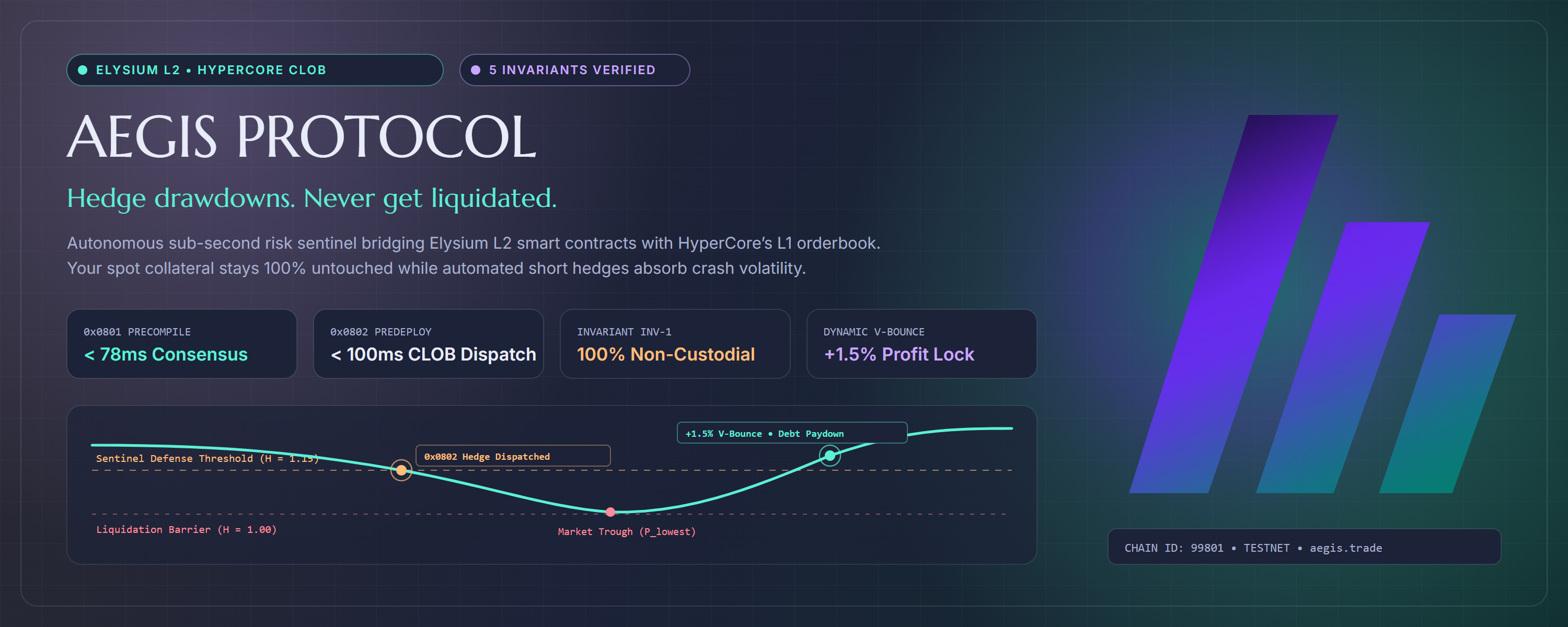
**AEGIS** introduces an autonomous, non-custodial risk engine and synthetic delta-hedging protocol designed for the Elysium Orbit L2 ecosystem and HyperCore (Hyperliquid's L1 high-performance CLOB). Rather than liquidating spot collateral, AEGIS dynamically neutralizes directional downside exposure ($\Delta$) by dispatching counterbalancing short perpetual futures contracts on HyperCore before liquidation thresholds are breached. Spot collateral remains 100% intact within the user's primary vault under zero-custody delegation (Invariant **INV-1**).
To ensure immediate testability on stock Arbitrum Nitro ArbOS prior to the upcoming validator hardfork, AEGIS implements a **Modular Dual-Mode Architecture**, operating via modular oracle and dispatch adapters today and hot-swapping to native zero-gas precompiles (`0x0801` and `0x0802`) post-hardfork with zero vault migration. The protocol enforces Phase 1C deferred fee debt accounting, guaranteeing that emergency unwind operations are never blocked by liquidity deficits. Across 14 Foundry test suites, 5 Keeper test suites, and 6 live RPC verification suites, AEGIS maintains a 100% pass rate across 157 automated tests.
***
## Key Protocol Pillars
| Architectural Pillar | Protocol Guarantee | Verification Metric |
| ---------------------------------- | ---------------------------------------------------------------------------------- | ----------------------------------------------------------- |
| **Zero Custody Loss (INV-1)** | Collateral never moves out of the user vault; session keys are trade-only. | 160,000+ fuzz runs, 0 unauthorized balance movements |
| **Modular Dual-Mode Stack** | Operates on stock ArbOS today, hot-swapping to native 0x0801/0x0802 post-hardfork. | `RelayedOracleAdapter.sol` + `AgentDispatchAdapter.sol` |
| **Phase 1C Non-Blocking Debt** | Unwinds never revert if liquid USDC is zero; fees are tracked in `feeDebts[user]`. | 100% pass rate on zero-balance stress tests |
| **50/50 Fee Conservation (INV-4)** | 10% fee strictly divided between Ascend buyback-burn and Sentinel node yield. | Tested across all unwind amounts in `AegisFeeCollector.sol` |
***
## Navigating This Lightpaper
Follow the reading order in the sidebar or jump directly to:
* [Part I: Introduction](/aegis/part-i-introduction/liquidation-crisis.md) — The liquidation crisis and the "Hold the Line" thesis.
* [Part II: System Architecture](/aegis/part-ii-system-architecture/system-overview.md) — Vaults, Sentinels, and the HyperCore L1 CLOB bridge.
* [Part III: Mathematical Specifications](/aegis/part-iii-mathematical-specifications/health-factor.md) — Formal definitions of Health Factor ($H$), sizing ($\gamma$), and unwinds ($\tau$).
* [Part IV: Fee & Liquidity Settlement](/aegis/part-iv-fee-and-liquidity-settlement/deferred-fee-debt.md) — Non-blocking Phase 1C deferred debt.
* [Part V: Sentinel Keeper Network](/aegis/part-v-sentinel-keeper-network/bonding-slashing.md) — 25,000 $AEGIS bonding and cryptographic boundaries.
* [Part VI: Tokenomics](/aegis/part-vi-tokenomics-and-value-capture/supply-flywheel.md) — Fixed 700M cap and deflationary Ascend buyback-and-burn flywheel.
* [Part VII: Formal Verification](/aegis/part-vii-formal-verification-and-proofs/invariants.md) — Invariants INV-1 to INV-5 and test scorecard.
* [Part VIII: Protocol Roadmap](/aegis/part-viii-protocol-roadmap/milestones.md) — Milestone tracking to Mainnet Genesis.
---
# Agent Instructions
This documentation is published with GitBook. GitBook is the documentation platform designed so that both humans and AI agents can read, navigate, and reason over technical content effectively. Learn more at gitbook.com.
## Querying This Documentation
If you need additional information that is not directly available in this page, you can query the documentation by asking a question.
Perform an HTTP GET request on the following URL with the `ask` and `goal` query parameters:
```
GET https://aegis-hedge.gitbook.io/aegis/readme.md?ask=&goal=
```
`ask` is the immediate question: it should be specific, self-contained, and written in natural language.
`goal` is what the user is ultimately trying to achieve, the reason they need the answer. Sharing it helps GitBook give you a better, more relevant answer. A goal is most helpful when it describes the outcome the user wants rather than restating the question. For example, with `ask=how do I create an API token`, a goal like `automate deployments from our CI pipeline` lets GitBook tailor the answer to that use case.
The response will contain a direct answer to the question and relevant excerpts and sources from the documentation.
Use this mechanism when the answer is not explicitly present in the current page, you need clarification or additional context, or you want to retrieve related documentation sections.